
Knee Osteoarthritis
Definition
Degenerative joint disease due to progressive loss of articular cartilage of knee joint
Epidemiology
Global prevalence is around 22.9% in those over 40
Mechanism
- Damage beyond repair
- Obesity, malalignment and prior injury raise the load
- Abnormal loading > Imbalance in joint force > Activate cellular components of OA pathophysiology
- Pain does not correlate well with radiographic severity
Risk factors
- Age
- Female > Male
- BMI (Overweight 2.5x, Obesity 5x)
- Previous knee injury (OA risk about 4x higher after ACL injury, 6x after meniscal injury)
- Malalignment and occupational loading
- Genetic (first-degree relatives)
Clinical Presentation
Symptoms
- Joint pain
- Stiffness < 30mins
- Swelling
- Reduced function (especially an inability to squat)
- Clicking sensation
- Instability
Signs
- Gait disturbance
- Joint deformity (mostly varus)
- Crepitus
- Tenderness (bony)
- Joint swelling (bony vs soft tissue vs effusion)
- Limited ROM
Diagnosis
Mostly clinical diagnosis.
Diagnostic criteria by American College of Rheumatology (ACR)
- Clinical + radiography: Knee pain PLUS osteophyte on x-ray AND at least 1 of 3:
- Crepitus
- Age >50
- Stiffness <30mins
EULAR recommendation
“In adults aged ≥45 years presenting with the above signs and symptoms, a firm diagnosis of knee OA can be made without radiographic assessment or even when the subject’s radiograph appears normal.”
Plain radiograph
- Must be weight-bearing / standing AP to analyze joint space narrowing
- Lateral
- Skyline view – analyze patellofemoral joint
- Findings: Joint space narrowing, osteophytes, subchondral cyst, subchondral sclerosis
- Kellgren-Lawrence Grading System
Ultrasound
- To be used as adjunct, provide additional value not for diagnosis but rather for monitoring of the progress & guided intervention
- Findings (mnemonic: ‘Ortho Sees Every Fluid Makes Pain Bad’)
- Anterior – Effusion & synovitis at suprapatellar fossa, Trochlear cartilage thickness
- Medial – Osteophytes, Medial meniscus extrusion (MME), Pes anserinus bursitis
- Posterior – Baker cyst
Blood / synovial fluid
- Only if gout, inflammatory or septic arthritis is suspected
*Caution: radiographic severity does not predict pain or response to exercise, so do not withhold exercise because of a poor radiograph.
Management
- First-line: education, exercise and weight management (if overweight)
- Trial of SYSADOA (Symptomatic Slow Acting Drug for OA) such as Piascledine, Glucosamine Sulphate, Mobithron Advanced. Recommend for 1-2 cycles, if no improvement, can stop
- Non-surgical interventions include:
- Steroid Injection
- Hyaluronic Acid Injection
- PRP Injection / HA-PRP Injection
- Stem Cell / Non-Cellular Therapies
- Ultrasound-Guided Nerve Blocks (e.g. Adductor Canal Block / Genicular Nerve Block)
- Radiofrequency Ablation
- Surgical options
- High tibial osteotomy (bone realignment)
- Partial knee replacement
- Total knee replacement
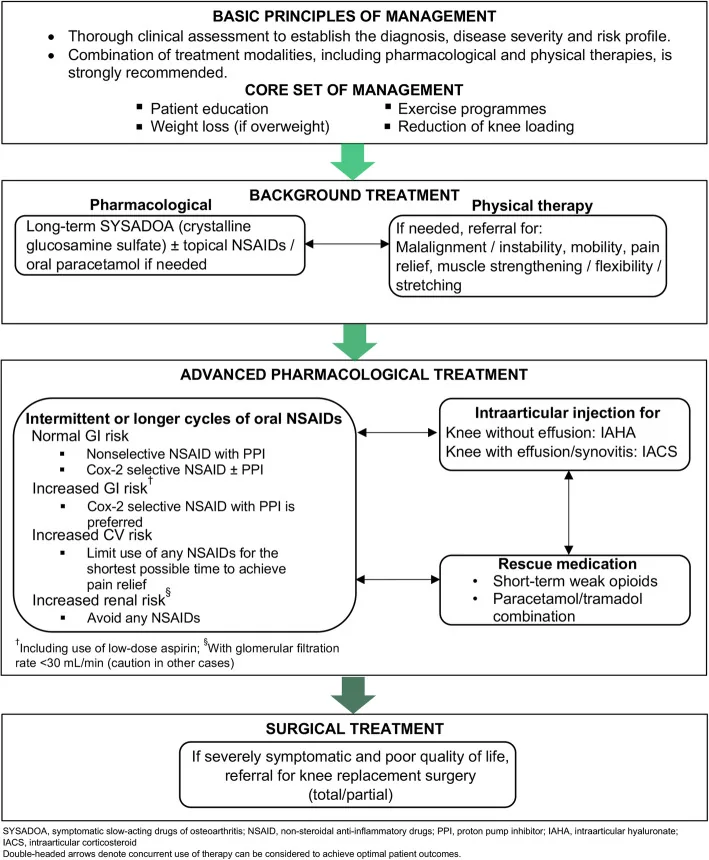
Recommended algorithm by the Malaysian consensus on the management of knee OA (2021)
Red flags and when to refer
Same-day assessment (ED or orthopaedics)
- Hot swollen joint with fever (septic arthritis).
- Acute locked knee or fracture.
- Suspected inflammatory arthritis or crystal arthropathy needing urgent workup.
Refer to sports medicine
- Disabling pain despite 3 months of optimised care
- Consideration of pain intervention
This summary is for educational use by healthcare professionals and does not replace clinical judgement.
References
- Kolasinski, S.L., Neogi, T., Hochberg, M.C., et al. (2020). 2019 American College of Rheumatology/Arthritis Foundation Guideline for the Management of Osteoarthritis of the Hand, Hip, and Knee. Arthritis Care & Research, 72(2), 149-162. https://doi.org/10.1002/acr.24131
- Bannuru, R.R., Osani, M.C., Vaysbrot, E.E., et al. (2019). OARSI guidelines for the non-surgical management of knee, hip, and polyarticular osteoarthritis. Osteoarthritis and Cartilage, 27(11), 1578-1589. https://doi.org/10.1016/j.joca.2019.06.011
- Fransen, M., Harmer, A.R., van der Esch, M., et al. (2015). Exercise for osteoarthritis of the knee. Cochrane Database of Systematic Reviews, 2015(1). https://doi.org/10.1002/14651858.cd004376.pub3
- Skou, S.T., Roos, E.M., Laursen, M.B., et al. (2015). A Randomized, Controlled Trial of Total Knee Replacement. New England Journal of Medicine, 373(17), 1597-1606. https://doi.org/10.1056/nejmoa1505467
- Cui, A., Li, H., Wang, D., et al. (2020). Global, regional prevalence, incidence and risk factors of knee osteoarthritis in population-based studies. EClinicalMedicine, 29-30, 100587. https://doi.org/10.1016/j.eclinm.2020.100587
- McAlindon, T.E., LaValley, M.P., Harvey, W.F., et al. (2017). Effect of Intra-articular Triamcinolone vs Saline on Knee Cartilage Volume and Pain in Patients With Knee Osteoarthritis. JAMA, 317(19), 1967. https://doi.org/10.1001/jama.2017.5283
- Panunzi, S., Maltese, S., De Gaetano, A., et al. (2021). Comparative efficacy of different weight loss treatments on knee osteoarthritis: A network meta‐analysis. Obesity Reviews, 22(8). https://doi.org/10.1111/obr.13230
- Poulsen, E., Gonçalves, G.H., Bricca, A., et al. (2019). Knee osteoarthritis risk is increased 4-6 fold after knee injury: a systematic review and meta-analysis. British Journal of Sports Medicine, 53(23), 1454-1463. https://doi.org/10.1136/bjsports-2018-100022
- Yeap, S. S., Abu Amin, S. R., Baharuddin, H., Koh, K. C., Lee, J. K., Lee, V. K. M., Mohamad Yahaya, N. H., Tai, C. C., & Tan, M. P. (2021). A Malaysian Delphi consensus on managing knee osteoarthritis. BMC musculoskeletal disorders, 22(1), 514. https://doi.org/10.1186/s12891-021-04381-8
Related
Medical disclaimer: this article is general information, not personal medical advice. Always consult a qualified doctor about your own situation.