Dr Harith's Services
IIUM Sports Medicine Clinic (ISMEC) sees people whose movement has been interrupted — a knee that gives way, a shoulder that will not lift, pain that has outlasted the injury that started it. Dr Muhammad Harith Rosdi assesses the problem, explains what is causing it, and sets out the options in plain terms. Some of those options are exercises. Some are injections. Some are a referral to a surgeon, when that is genuinely the right answer.
Before your first visit
No referral letter is needed. You can contact the clinic directly on WhatsApp and book an appointment yourself. Most people who come here have not seen another specialist first.
The first appointment is an assessment, not a treatment session. It usually means:
- Talking through how the problem started, what makes it worse, and what you have already tried
- Examining the joint or muscle — how it moves, what it cannot do, where it hurts
- Ultrasound in the clinic, when the diagnosis depends on seeing the tissue itself
- An explanation of what is going on, in words that do not require a medical degree
- A written plan for what happens next
An appointment usually runs about 30-45 minutes. Walk-ins are welcome but appointments by WhatsApp booking is preferred to check clinic availability.
Bring any imaging you already have — X-ray films, MRI or ultrasound reports, even if they were done elsewhere. Old scans are still useful: they show where things started. Bring a list of your medicines, and wear or bring the shoes you train in if the problem is in your leg or foot.
If an X-ray is needed, we arrange it: you are taken across to SASMEC @IIUM on the same campus by buggy or van, and the transfer is organised by the clinic. If an MRI is needed, we can arrange the scan for you — or you can bring the CD from a scan done elsewhere and we will review it here.
Sports Injuries
"Tired of being told to just stop playing?"
"Not sure if that knee injury actually needs surgery?"
Most sports injuries are diagnosed by listening carefully and examining properly, not by ordering a scan first. The examination tells us which structure is injured; imaging confirms it when the picture is unclear.
- Assessment by a sports medicine specialist
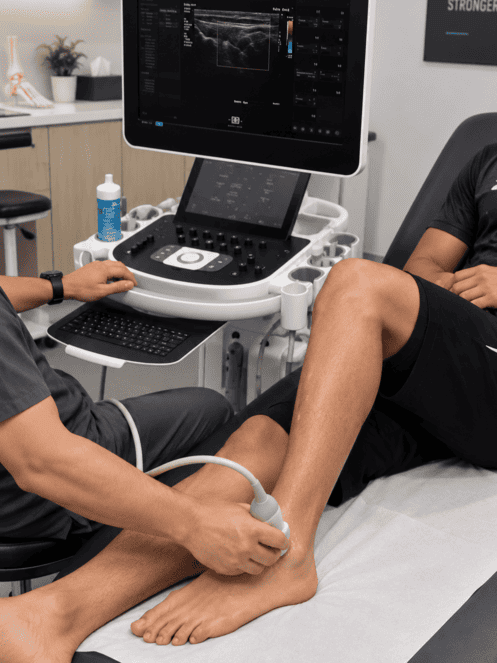
- Musculoskeletal ultrasound, for accurate assessment of muscle and tendon injuries
- Focused rehabilitation
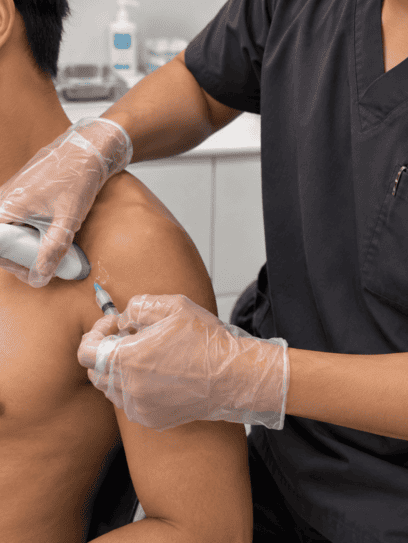
- Ultrasound-guided regenerative injections (for example platelet-rich plasma for hamstring tears)
When to come in sooner rather than later: a joint that gives way or locks, swelling that does not settle after a few days, a calf or thigh that tore with a visible snap, or any injury that has not improved in two to three weeks despite rest.
Chronic Pain
"Suffering for months, even years, with no real answers?"
Persistent pain is a different problem from a fresh injury, and it needs a different approach. The question is rarely "which injection" — it is "which structure is generating this pain, and why has it not settled".
The procedures below are options discussed after assessment, not a menu to choose from:
- Steroid injection
- Prolotherapy
- Platelet-rich plasma (PRP)
- Nerve block
- Nerve hydrodissection
- Joint hydrodilatation
Each has a reason to be used and a reason not to be. Part of the consultation is explaining which applies to you, and which does not.
Wellness and performance
"Training for a marathon or HYROX?"
- Pre-competition medical assessment and sports screening
- Doping consultation
- Exercise prescription
- VO2 max testing (coming soon)
Exercise prescription is not a generic gym plan. It is a written programme built around your injury history, your training load and what you actually intend to do with your body.
What ultrasound adds, and what it does not replace
An X-ray shows bone clearly and shows soft tissue poorly. Ultrasound shows muscle, tendon, ligament and fluid, in real time, and lets the injured side be compared with the other one in the same sitting. It can also show a tendon moving, catching or fraying as the joint moves — information a still image cannot carry.
It does not replace MRI in every case. MRI sees deeper structures, bone marrow and the inside of a joint in a way ultrasound cannot.
What this clinic is not
- Not a walk-in general practice for coughs, fevers or unrelated medical problems.
- Not a quick-injection clinic. An injection given before a diagnosis is a guess with a needle.
- Not only for athletes. If pain is limiting your walking, your work or your sleep, that is reason enough to be assessed.
How the pathway usually runs
- Assessment — history, examination, and imaging where it changes the answer.
- Diagnosis — a named problem, not a vague region of pain.
- Treatment — the least invasive option that fits the diagnosis, which for many people means loading and rehabilitation rather than an injection.
- Rehabilitation — structured, progressive, and measured against what you need to return to.
- Return — criteria for going back to training or sport, rather than a calendar date.
You are not handed between disconnected providers. The assessment, the injection, the rehabilitation plan and the return decision sit with the same team.
Questions people ask
Do I need a referral?
No. Contact the clinic on WhatsApp and book directly.
How much does it cost?
Fees are not published here. Ask on WhatsApp and you will be given the current fee for the appointment or procedure you are asking about, before you commit to anything.
Will I need surgery?
Surgery is one option among several. Whether it is the right one depends on the diagnosis — which is precisely what the assessment establishes. If surgery is the answer, you are referred to a surgeon rather than talked into one.
Can I be seen for a second opinion?
Yes. Bring whatever you were told before, and whatever imaging you have.
Do you treat people who are not athletes?
Yes. The clinic sees anyone whose movement or daily function is limited by a musculoskeletal problem — including people who have never played sport in their lives, including elderly and teenagers.
Book an appointment
Contact the clinic on WhatsApp to arrange an assessment at IIUM Sports Medicine Clinic (ISMEC), IIUM Kuantan Campus (near Mahallah Maimunah), Kuantan.